2026-2
Fattme
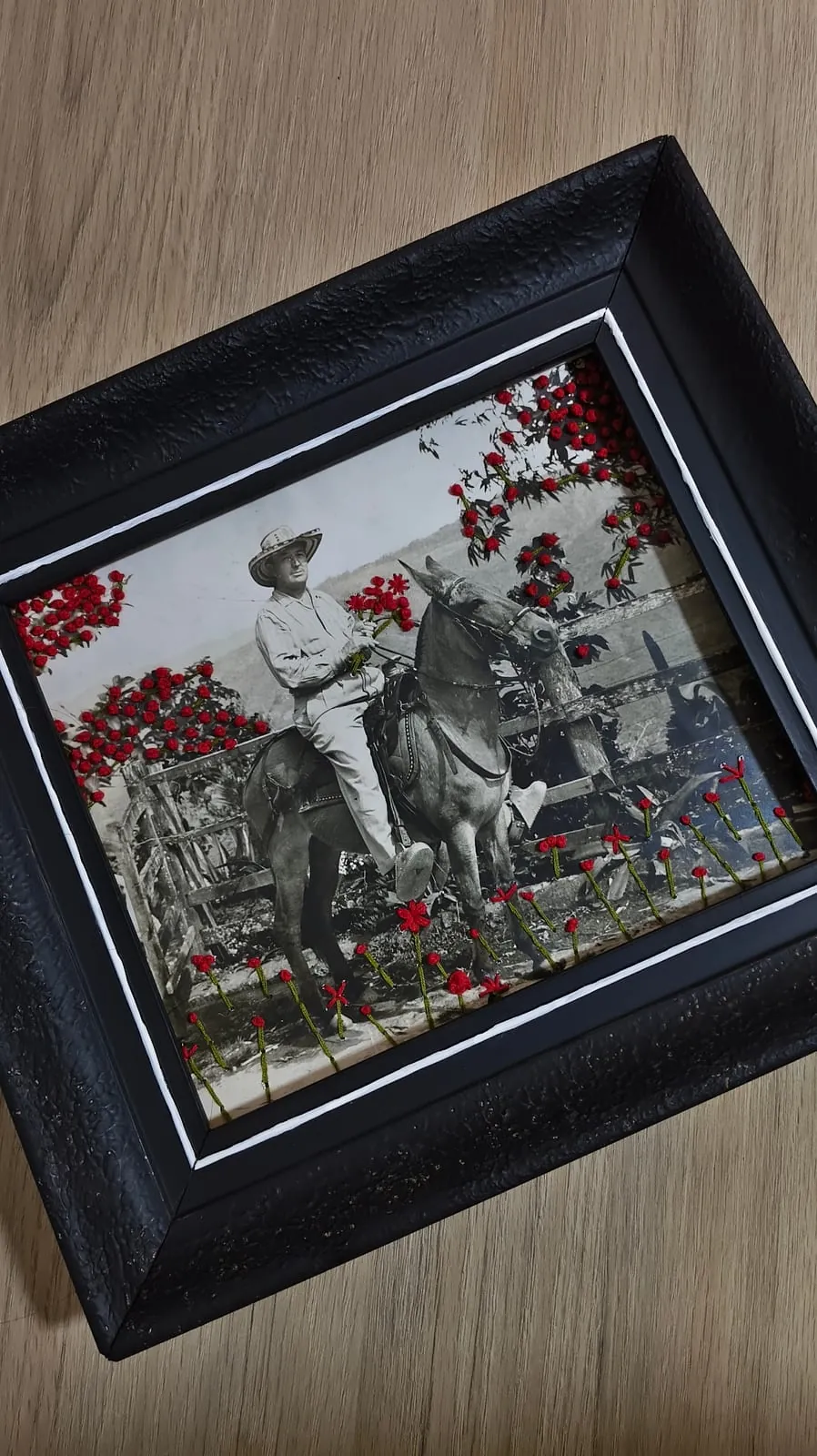
This piece starts from a photograph found in the personal archive of Fattme Abdawuali, altered through the photo-embroidery technique as part of the work Fattme, presented at the third Research + Creation exhibition Raíces, Archivo Latinoamérica: El rastro de lo invisible (Roots, Latin American Archive: The Trace of the Invisible), organized by the Faculty of Design of the Universidad de Medellín, Strat Com and ConCiencia.
Through the incorporation of threads and stitches onto the photographic image, the intervention establishes a dialogue between memory, textile craft and identity, transforming a record of the past into a living medium of artistic expression. The embroidery not only visually modifies the photograph, but adds new layers of meaning, turning the act of intervening into a form of care, reconstruction and recognition of an individual history. The piece seeks to make visible what time and oblivion have left at the margins, showing how textile knowledge can become tools for preserving and transmitting memories.
Installation of archive objects altered with woven fabrics, embroidery and coatings of natural materials and biomaterials, complemented by a sound piece of narrated text.
We are convinced. The interweavings of ordinary, everyday people -in the broadest sense of those words- reach rational scopes that surpass time and space, living and dying, memory and stillness.
In this vein, contemporary creation and artistic research overcome what was once considered an irreconcilable dilemma. The relationships between the contemporary and art as a latent possibility of life are a material reality; they can be touched, stretched, used and enjoyed. Science and art do not keep the ashes of past times; rather, they offer the possibility of navigating a living map of superimposed identities.
On this horizon, the project starts from a fortuitous find in the margins of the everyday, namely discarded things: a fragmented archive that safeguards the material traces of a woman named Fattme Abdawuali. This collection, made up of handwritten letters, faded photographs, press clippings and some personal objects, finds its core of poetic and conceptual tension in an embroidery notebook that preserves physical samples of styles, stitches and textile types. The interwoven threads of this find will give us the material validity of the triad: science, art and life.
Far from being understood as a set of static pieces, this archive is activated as a processual work and a device of interpretation. The research-creation proposed here immerses itself in residue and fragment to interrogate historical silence, oblivion. Fattme's embroidery notebook is not just a technical sample book; it is a manuscript of textures and bodily graphies that operates as a counter-narrative to cultural homogenization. Through sensitive cataloguing, exploration of materials and the aesthetic reconfiguration of these vestiges, this project introduces a reflection on how Latin American microhistories and identity transit are physically inscribed in the most fragile supports, revealing that memory is, above all, an event that is carried, worn, used and inherited through touch and craft.