2026-2
Earth Archive
What would happen if a global digital and environmental collapse erased all identity records, and communities had to rebuild their history from oral memory and available resources?
In a future where the growing dependence on digital technologies causes the loss of records of identity, memory and heritage, it is worth asking ourselves: will all the physical records of our communities be lost, making us forget our ancestry and, consequently, who we were?
The chosen crisis is the “Dematerialization of the world”, understood as a process in which more and more aspects of life such as identity, memory, heritage, relationships and knowledge depend on digital and virtual infrastructures. In this context, culture runs the risk of no longer being contained in physical objects, spaces and practices, and instead being stored in technological systems that are neither completely stable nor accessible to everyone.
The question relates to the crisis of the Dematerialization of the World because it poses a future where the growing dependence on digital technologies causes the loss of records of identity, memory and heritage. Imagining a digital and environmental collapse exposes the fragility of storing history mainly in technological media. Faced with this situation, communities would have to recover non-digital ways of preserving their identity, such as oral memory, stories, objects and ancestral knowledge. Thus, the question challenges technological dependence and allows us to recognize community knowledge as a resilient way of preserving and rebuilding history.
We studied the Pastás indigenous reserve, located in Aldana, a Colombian municipality in the department of Nariño. It is 95 kilometers from San Juan de Pasto, the capital of the department. It borders the municipalities of Guachucal and Pupiales to the north; Ipiales and Cuaspud to the south; Guachucal and Cuaspud to the west and Pupiales to the east.
Pastas Aldana was selected because of the close relationship that currently exists between its memory, oral tradition, community knowledge and territory, since its stories, trades and traditional/ancestral practices have been passed down between generations thanks to its oral tradition and collective experiences, which are its main source of preserving its identity.
This characteristic is closely linked to our speculative future, since it allows us to imagine how this knowledge could become the main means of rebuilding a community's memory and identity after a digital and environmental collapse.
This future is not far from the one we propose, since its customs must be preserved because of the effects of climate change, which means that ancestral traditions are directly affected.
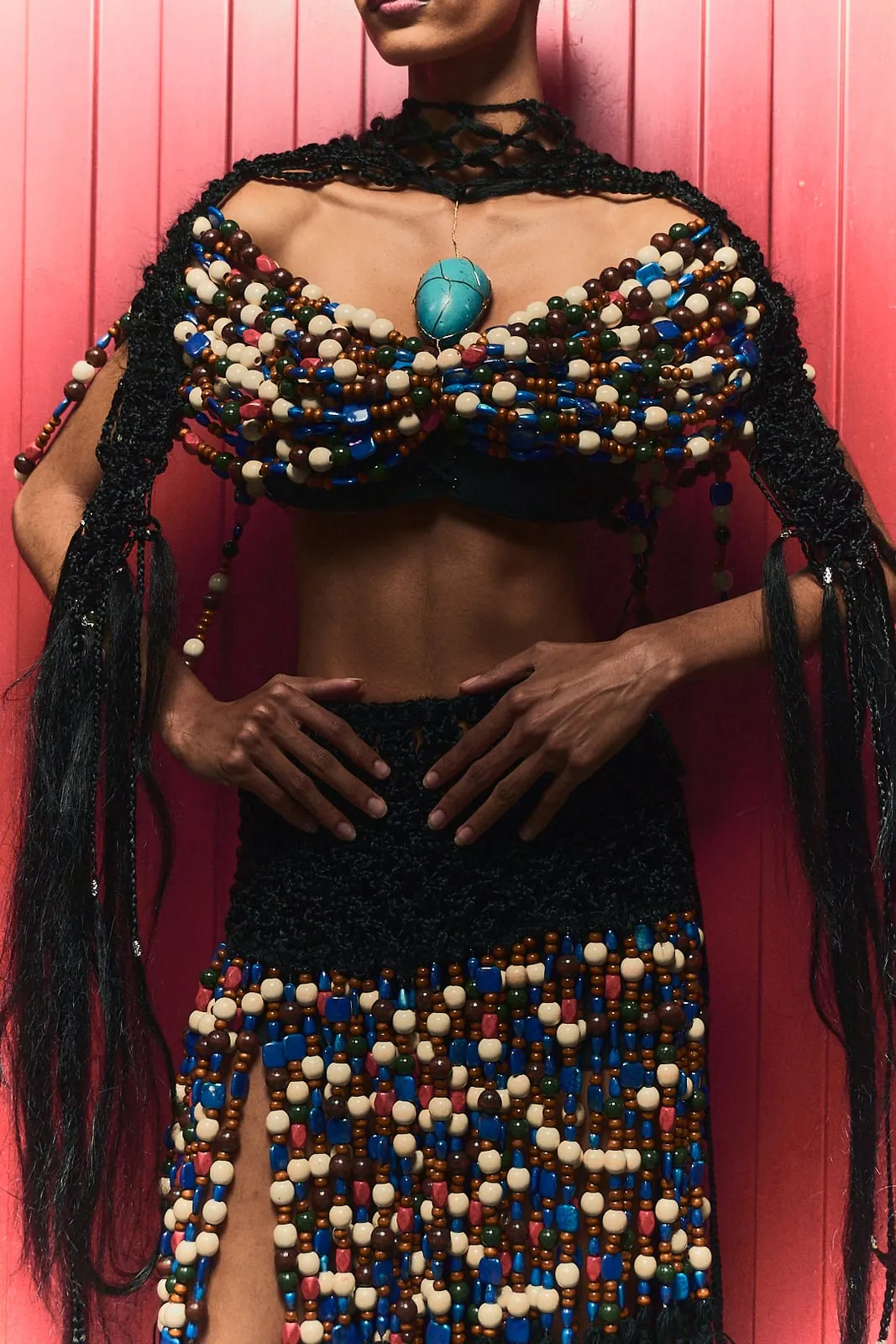
We took part in the Pasarela Futurista (Futurist Runway) by creating and presenting a speculative fashion proposal that materializes the scenario set out in our research: a future after a digital and environmental collapse in which communities have lost their identity records and must rebuild their history from memory, objects and available material resources.
Clothing will function as a device of memory and identity, exploring the relationship between the technological and the material. Through the costumes, the aim is to represent how, when digital systems disappear, physical objects can once again become carriers of information, memories and collective stories.